Commission 1: The Dunmore Arms
Mrs. Dunmore's key opens everything. Ada's opens Unit A and the front door. Bo's opens Unit B and the front door. Nobody opens a neighbour's room. Tap a square, then tap a depth.
Try this: tap “cut it for me” on Mrs. Dunmore's row, then “copy hers” on Ada's, then change two of Ada's chambers. Watch what Unit A answers to.
Three rules. That's the whole rulebook.
A key here is a row of cuts, one depth from 1 to 6 per chamber. A lock is pinned for certain depths in each chamber; those are its shear lines.
- A key opens a door when every cut lands on a shear line in that door's lock.
- Each lock is pinned for exactly the keys the work order says must open it. So every ✓ takes care of itself.
- Every extra shear line costs a wafer (two depths in one chamber is one wafer). And wafers combine.
That third rule is the game. A door pinned for two keys that differ in two chambers answers to four cut codes. Two of them belong to nobody. Locksmiths call those ghost keys. KEYWAY calls them phantoms, and the door's card counts them, with examples, the moment the lock is pinned.
“Any legal bitting will do: the chart doesn't care about your numbers, it cares about your differences.”Margie Okafor, KEYWAY's coach. Forty years at the bench, all of them fictional
That's basically it. On a broom closet, a phantom is arithmetic. Commission 3 puts one on a vault.
A phantom on a vault is a burglary that hasn't happened yet.
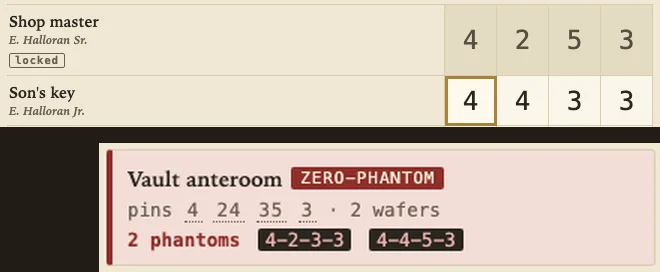
That's Margie again, at Halloran & Sons, the jewelers. The vault anteroom has to go zero-phantom. Senior keeps his key as cut. Junior's was recut in '09 by whoever had the bench that year, and it sits two chambers off his father's.
So the vault shows up answering to four codes. Two of them, 4-2-3-3 and 4-4-5-3, are on nobody's ring.

Junior will take a new key if you say so. It takes one chamber. Which one, and what that does to the bench key and the cleaner's key, is the commission.
Par isn't my guess. A solver proved it.
Every commission has a par: the fewest wafers any chart can spend and still earn every star on offer, with the locked keys left as they are. A search program checks every chart that could beat it and rules each one out. With every star earned, you can tie par and nobody can beat it, me included. A broken chart can come in under: Westbrook's bad draft arrives at 4 wafers against par 5.
| Commission | Par | Search steps | Proof time (one laptop) |
|---|---|---|---|
| The Dunmore Arms | 4 | 71,704 | 4 ms |
| Westbrook Dental | 5 | 30,466 | 6 ms |
| Halloran & Sons | 6 | 48,080 | 4 ms |
| The Grandview | 8 | 1,347,433 | 35 ms |
| St. Bridget's Clinic | 8 | 7,123 | 2 ms |
| Rekey: the Langford | 6 | 11,199 | 4 ms |
For scale: against the master from the game's own solution (3-5-2-4), there are 1,219,920 legal ways to cut Ada's and Bo's keys. 380 earn both stars, and 80 of those mint no phantom anywhere. On the five after the Dunmore, a script threw 200,000 random charts at each. Westbrook and Halloran's let 4 and 3 through. The last three: none.
It also ships with 30 tests. One of them cuts every key as one flat number (1111, 6666, 3333) and fails the test suite if that ever earns every star.
Six buildings, one new problem each
- The Dunmore Arms. A landlady, two tenants, three doors. Margie talks you through it.
- Westbrook Dental. An audit. The last locksmith's draft lets the superintendent into the operatory. The locksmith's name isn't going on the chart. Yours is.
- Halloran & Sons. The vault goes zero-phantom. Junior's key mints two phantoms on it.
- The Grandview. A hotel. Housekeeping gets the rooms, the linen store and the office, never the safe closet. Two factory keys are locked, and they differ in chamber five alone.
- St. Bridget's Clinic. The diocese master is 2-4-6-4-2 and the cutter can't step more than two depths between neighbouring cuts. Margie's warning: half your depths are illegal before you start.
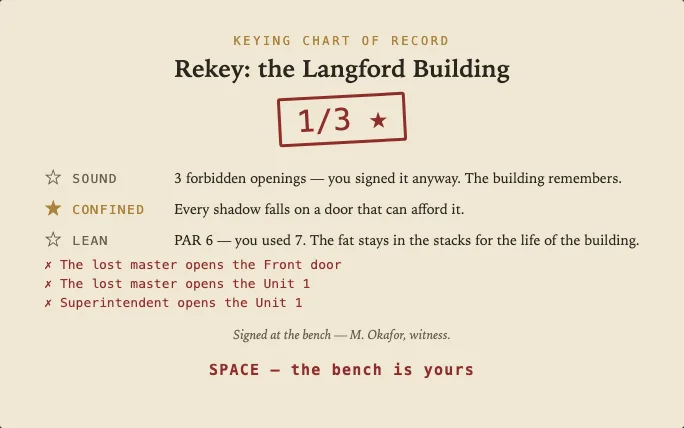
- Rekey: the Langford. The master is lost, bitting known: 3-5-3-5-3, on a ring somewhere in the city. It has to open nothing when you're done, front door included. Mrs. Okonkwo has had her key for thirty years and she's keeping it. It sits one chamber off the lost master.
Margie's briefing for that last one ends with “Find the chamber this building turns on.” It's a good line to read with the chart in front of you.
You're allowed to sign it wrong.
SIGN works the moment every key is cut, legal, and different from the others. Trespasses and phantoms don't stop you. The chart ships with its flaws listed in red, and the title screen keeps them next to the building's name: “signed with 2 phantoms on secure doors.”
There's no retry menu after you sign. Before you sign, undo goes all the way back and R recuts the whole commission from the work order. After, the title strip remembers what you put your name on.
Honest gripes before you click
- It's a toy version of the trade. Real systems run more pins, more depths, and tricks this game skips entirely (top masters, rotating constants, tolerances). Every lock here gets pinned for exactly its keys and nothing more. The words are the trade's. Its math is smaller.
- You need a keyboard. The title screen and the report card only move on SPACE, so the full game won't start on a phone. The Dunmore demo up top works fine under a thumb.
- Six buildings, then it stops. It's the first slice of a bigger game that doesn't exist yet.
- Nobody outside my own test runs has played it. I can't tell you how long it takes or where people get stuck. I'd rather you know that.
- The third hint just hands you a cut. It reads from my solution, so if you're building toward a different par chart, it can point you somewhere else.
- No music. Small beeps when you cut.
Questions
- Do I need to know anything about locks?
- No. The three rules above are all of it, and Margie teaches the first building. If you do know locks, the words will be familiar.
- Is it really free?
- Yes. No account, no ads, nothing to buy.
- What's a wafer?
- One extra shear line in one chamber of one lock. Two depths in a chamber is one wafer; three depths is two. Par counts them across the whole building.
- What's MACS?
- Maximum adjacent cut spec: how far two neighbouring cuts on one key can differ before the cutter can't make the ramp. Break it and the chart won't sign.
- Is it like Opus Magnum?
- Same itch: a tiny rule set and a number to chase. Different floor: Opus Magnum's histograms show where other players landed. KEYWAY's par is the proved minimum for a chart that earns every star.
- How long is it?
- Unmeasured. For size: each commission is 12 to 15 cuts, 81 in all.
- Does it save?
- Yes, in your browser. Clearing site data wipes it. If you sign the Dunmore in the demo, the full game opens on commission 2.
- Could I key a real building with this?
- Please don't. See the first gripe.
Mrs. Dunmore is waiting on a chart.
Three keys, four chambers, par 4. Cut them up top, or open the full game and start at the bench with Margie.
P.S. If you sign the Dunmore Arms in the demo, the game remembers it. Open the full game and your stars are already on the title strip, with the dentist's audit up next.